SiPM Scintillator Based Detectors
Natalie Preble ’27
Faculty Mentor: Dr. Fadem
Other Research Team Members: This summer, I worked in the lab with my research partner Zachary Huseman! We worked together everyday to set up the telescopes for data taking, analyze our data, and plan our next steps. He also served as a mentor to me and taught me a lot about circuitry and other electrical components! We worked great as a team, since he preferred the more hands-on tasks like soldering and constructing circuitry, whereas I preferred to work with numbers and our data.
What is the broader impact of your summer research? That is, why should the world care about your work?
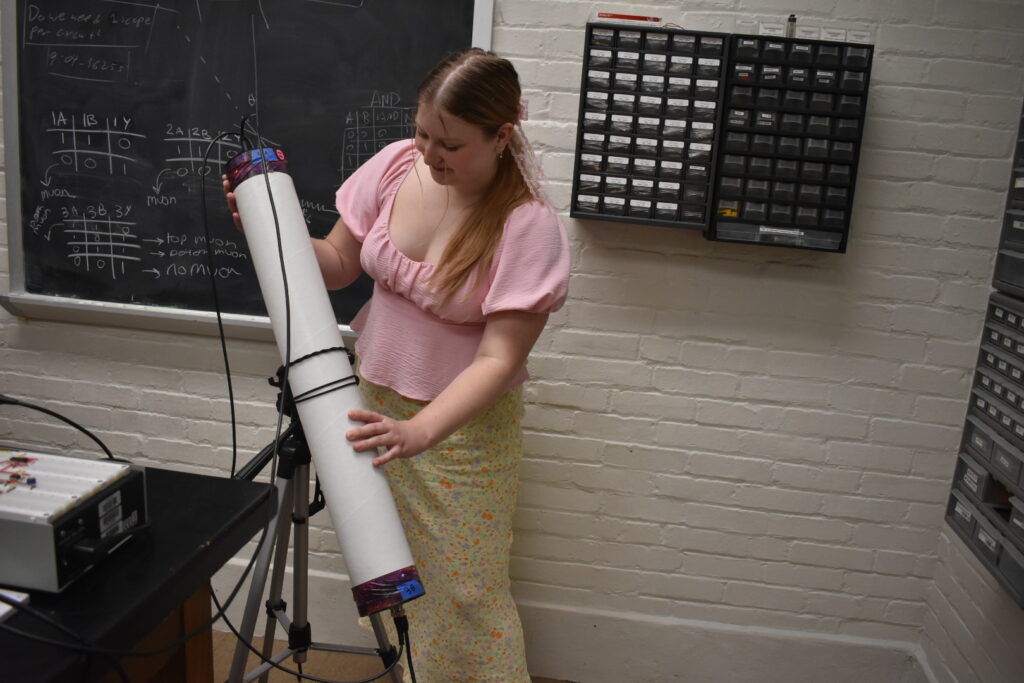
My summer research focused on the Brookhaven National Laboratory’s sPHENIX Detector, an experiment used to learn about Quark Gluon Plasma, a special kind of nuclear matter. The data from the sPHENIX Detector helps physicists understand the interactions between quarks, gluons, and larger particles. We focused our research on one specific component of the sPHENIX, the sPHENIX Event Plane Detector (sEPD). This component is fixed on both sides of the sPHENIX and monitors the outcome of the collisions and experiments run inside the detector. The sEPD is made of isolated scintillator tiles, a type of plastic material that creates photons. In our lab here at Muhlenberg, we constructed multiple Silicon Photomultiplier Scintillator based detectors to understand how they worked, so we’d be better equipped to analyze data from the sEPD at the sPHENIX Detector.
What has summer research taught you about yourself and the field that you researched and/or studied?
This summer, I learned that I am capable of thinking creatively, and adjusting accordingly when things don’t go as planned. I was challenged to think about physics in a different way, which enriched my understanding of the field. I was able to set goals for myself and achieve them, while also practicing flexibility and making adjustments when things didn’t go as expected. Overall, this summer I was truly challenged to think for myself and was given the resources to be successful in doing so. This summer taught me about how physicists conduct experimental research. I learned about different electrical components which helped me understand how larger electronics and machines aid physicists in collecting data. I learned how to build and operate a muon telescope. I learned how to effectively keep a lab journal, and what pieces of information were important for analyzing data accurately. I also learned about the different ways physicists reevaluate their data and construct new experiments and equipment to further study their findings.
What advice would you give to students considering a future research opportunity similar to the one you participated in?
To the students considering a summer research opportunity: I highly recommend that you take advantage of it. This summer was one of the best experiences I’ve had, and I truly felt like I was being challenged outside of being a student. I was able to learn about a field of study that interests me and build a relationship with my faculty mentor. I’ve always feared that I would never be able to accomplish something in the scientific world because I was only good at reading and remembering textbooks, and not actually thinking for myself. Yet this summer I was challenged to do just that, and the effects it has had on my understanding and confidence have been invaluable.